
About Us
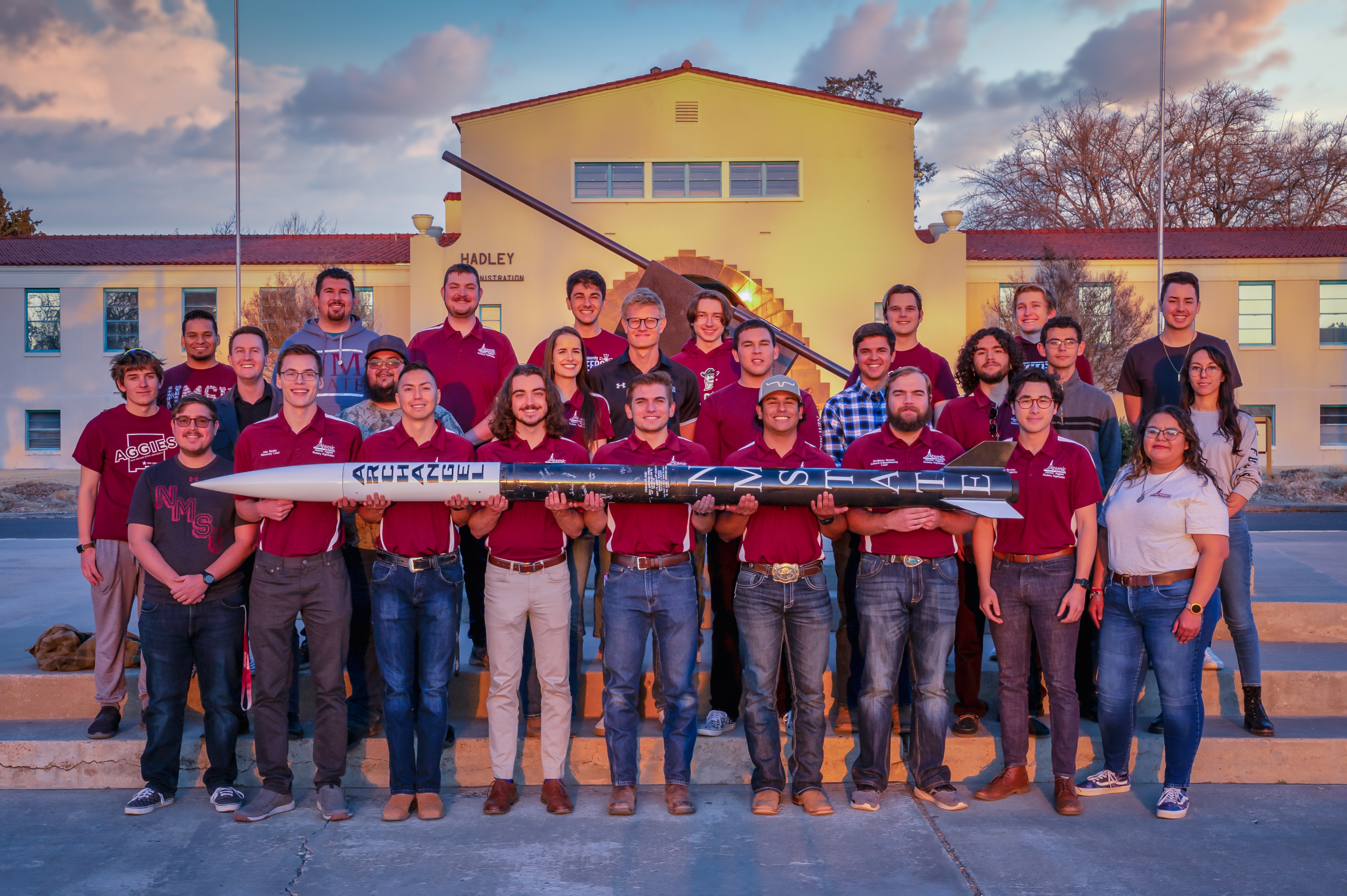
As a team, we design, manufacture, and test a new rocket each year for the Experimental Sounding Rocket Association's (ESRA) International Rocket Engineering Competition (IREC).
The IREC / Spaceport America Cup Experience
Each year, the Atomic Aggies represent NMSU in the Intercollegiate Rocket Engineering Competition (IREC) (also known as the Spaceport America Cup).
What is IREC?
Organized by ESRA, IREC brings together college rocketry teams from across the globe to design, build, and fly rockets to target altitudes (typically in the 10,000 ft or 30,000 ft categories).
Where & when?
Historically, the launch site was at Spaceport America in southern New Mexico. In 2025, the venue changed to Midland, Texas. The competition is held each summer, however, the team works year-round to complete a successful tested launch vehicle.
Our goals at IREC
- Altitude performance
- Payload integration
- Flight reliability and safety
- Innovation in design, materials, and systems
- Outreach and public engagement
Why we compete
IREC provides a rigorous, real-world testbed for our engineering efforts. Every stage—structural design, propulsion, avionics, recovery—is pushed to perform under competition constraints. It’s also where we meet other teams, exchange ideas, and benchmark our work against global peers.
Our past success
In recent years, the Atomic Aggies have competed strongly and earned recognition at the Spaceport America Cup / IREC events. For example, in 2023 we won the Chile Cup award among regional universities. Las Cruces Sun-News
How We Work
Atomic Aggies is more than a club—it’s an engineering lab, a community, and a collaboration hub. Here’s what our process and structure look like:
Organized by subteams
We divide work into functional areas: Avionics, Propulsion, Manufacturing, NAR, Payload, and Special Projects. Each subteam has leadership roles and coordinates interdependencies with other teams (for example, avionics must communicate with recovery, etc.). Read more about each of our teams on their respective pages!
Project phases
-
Concept & requirements — defining mission objectives, altitude, payload, constraints
-
Detailed design & simulation — CAD, FEA, simulation, trade studies
-
Fabrication & procurement — machining, 3D printing, electronics, sourcing
-
Assembly & integration — subsystem testing, system integration
-
Ground testing — static tests, validation, safety checks
-
Launch & flight operations — pre-launch checks, telemetry monitoring, recovery
-
Post-flight analysis & iteration — flight data, lessons learned, improvements
Culture & expectations
-
Hands-on learning: We expect all members to get their hands dirty—fabricating, testing, assembling.
-
Collaboration: Communication, documentation, and teamwork are critical.
-
Mentorship: Experienced members mentor newcomers; knowledge transfer is central.
-
Schedules & sprints: We break the year into planning cycles, deliverable milestones, and periodic reviews.
-
Safety & accountability: Safety protocols are enforced; mistakes become learning opportunities, but responsibility matters.
Getting Involved (Students)
Are you a student at NMSU (or planning to transfer)? Great. Rocketry doesn’t require a specific major—what matters is curiosity, drive, willingness to learn, and collaboration. Here’s how to jump in:
Join our info sessions / open houses
We regularly host “Intro to Atomic Aggies” sessions early in each semester. Watch our Events / News page and Crimson Connection for dates.
Contact us
Email atomicaggies@nmsu.edu with a few lines about your interests or experience.
Also check Crimson Connection for event announcements and sign-ups.
Start small
We often assign new members to manageable tasks or shadow existing subteams (e.g. sensor testing, wiring, CAD work) to get familiar with workflows.
Participate in workshops & training
We run sessions on soldering, machining, CAD, avionics, safety, etc. These help new team members ramp up quickly.
Contribute across disciplines
Whether your strength is coding, electronics, mechanical design, or project management—there’s a place for you. Interdisciplinary collaboration is one of our strengths.
Stay active & communicate
Attend meetings, volunteer for tasks, ask questions, share progress, and help document.
Joining early gives you more opportunity to take on leadership or technical roles as projects evolve.
Engaging the Community & Nonstudents
We believe rocketry is not just for students—it’s for everyone who looks up in wonder. Community involvement strengthens support, inspires the next generation, and shares what we build with the public. Here are ways we welcome you:
-
Outreach & STEM events
We host or participate in K–12 outreach, hands-on activities, and presentations in schools, museums, and public events to inspire youth interest in aerospace. -
Sponsor and industry partnerships
We partner with local businesses, alumni, and aerospace companies—not only for funding but for mentorship, internships, and shared technical resources. -
Donations & in-kind support
Community members can contribute via material donations (components, tools), funding, or helping with logistics, machining, or outreach support. -
Media & storytelling
We share our journey—successes, challenges, experiments—with the public via social media, local media, and our website to foster broad engagement and transparency. -
Alumni & mentor network
We welcome former members or professionals who want to guide, mentor, or share expertise. Your experience is invaluable.
If you represent a school, library, community center, or local organization and want us to do a presentation or workshop, just email atomicaggies@nmsu.edu.